D.M.V. Contract Activity
Timing in Everything - Part 2
What a difference a week—and a calendar—can make.
After last week’s holiday-driven slowdown, the metro DC housing market came roaring back with its strongest performance in months. With spring break in the rearview mirror and buyers refocused, contract activity surged in a way that underscores just how much timing influences weekly data.
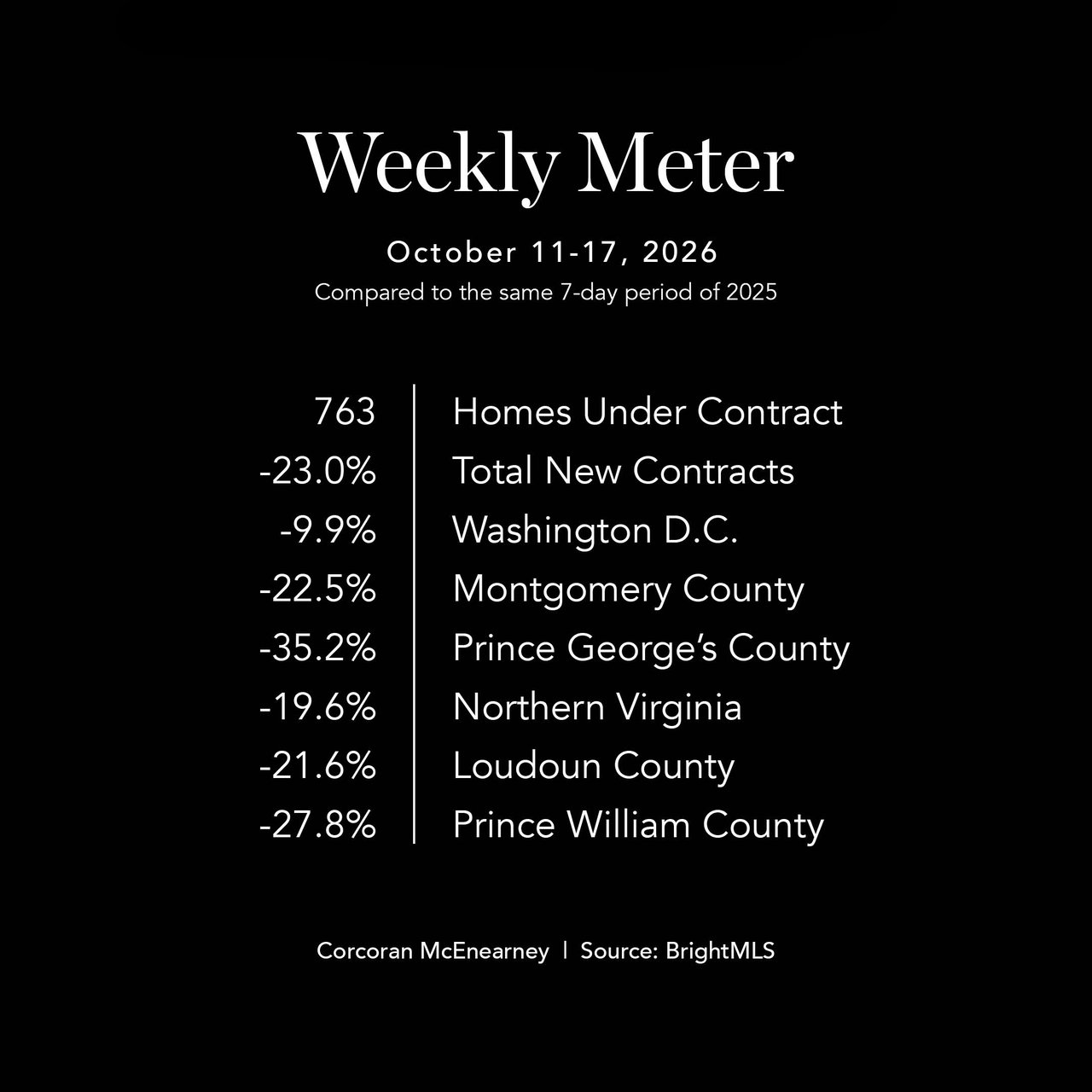
- Total contract activity jumped 20.1% year over year, with more than 1,500 newly ratified contracts—the strongest weekly performance in at least nine months.
- Five of six jurisdictions posted gains, reflecting broad-based strength across the region.
- Prince George’s County was the only exception, with a very modest 1.0% decline.
- Activity was particularly strong across multiple price points, including the upper-end market, with more than 160 contracts over $1 million in Northern Virginia alone.
- Average days on market rose from 25 days last year to 31 days this year, continuing the trend toward a more measured pace.
- This is the flip side of last week’s story—and a perfect illustration of why context matters as much as the numbers themselves.
- Last year, this same week fell squarely in the middle of spring break for most area school systems, suppressing activity. This year, with the calendar shifted, buyers showed up in force—and the market responded accordingly.
- But beyond the calendar effect, the strength of this rebound is notable. Demand didn’t just return—it accelerated, and across a wide range of price points. The surge in $1M+ activity is particularly telling, signaling confidence even in the face of economic uncertainty, geopolitical tensions, and elevated energy costs.
- At the same time, the increase in days on market reinforces a consistent theme: this is an active but more deliberate market. Buyers are engaging, but they are taking the time to evaluate options and negotiate thoughtfully.
- Every spring has a rhythm—and this week hit the “family vacation” beat.
- With Easter falling nearly three weeks earlier than last year and schools across the region on break, a temporary slowdown in contract activity was not just expected—it was practically scheduled. The encouraging part is what didn’t happen: the market didn’t lose momentum, it simply paused.
- Even more notable is the decline in days on market, which suggests that buyers who are in the market remain engaged and decisive. That’s a strong signal that demand hasn’t weakened—it’s just been temporarily distracted by airline tickets and beach reservations.
- Meanwhile, continued strength in Northern Virginia and DC underscores a familiar theme: well-positioned markets—and well-prepared listings—are still moving.
Blue Ridge Contract Activity
Shenandoah, Warren, Clarke, Fauquier, Frederick Counties, Winchester City, and West Virginia.
Timing Is Everything – Part 2 (Countryside Edition)
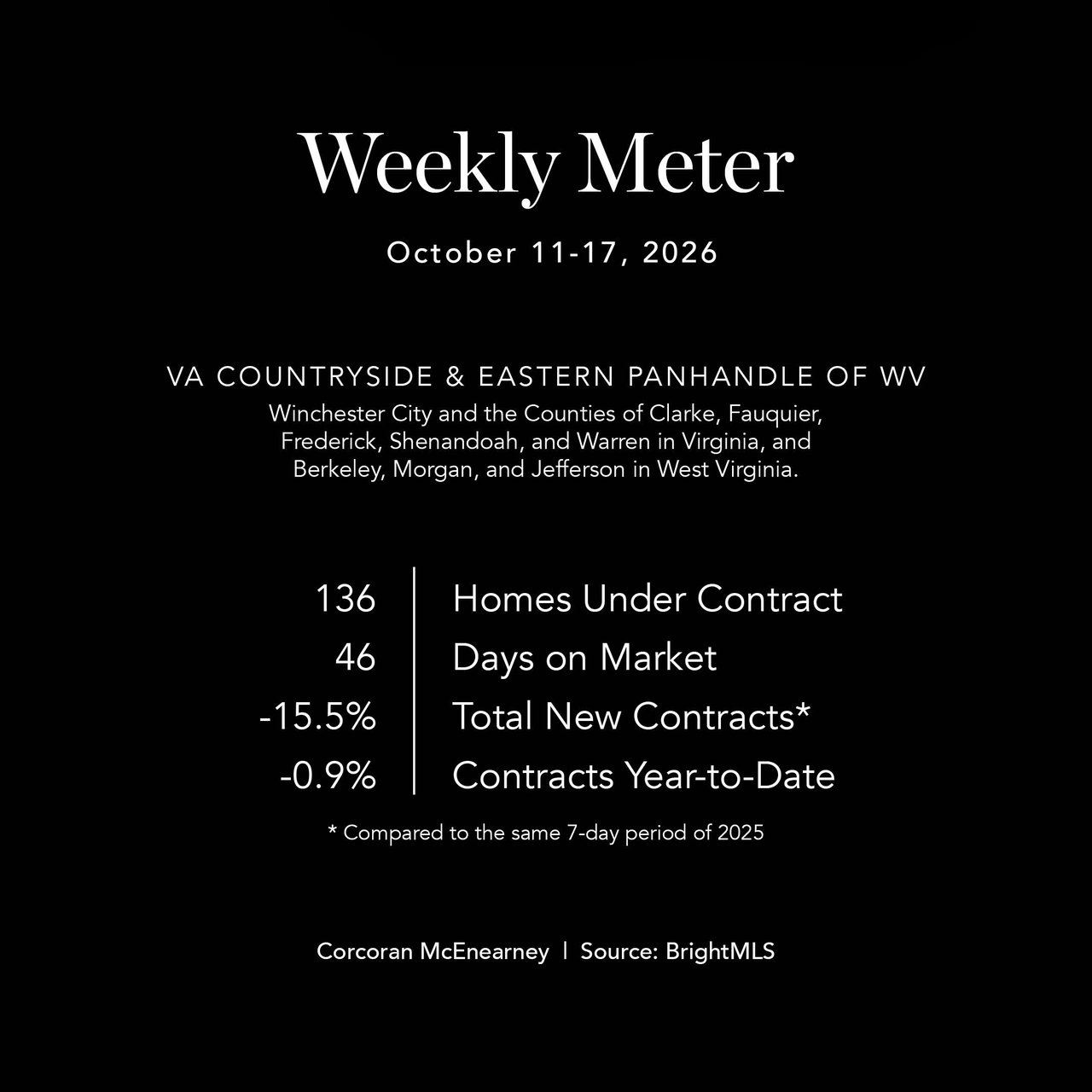
Apparently, the Countryside and Panhandle didn’t just recover from last week’s holiday lull—they made up for lost time. While the calendar may have slowed things down briefly the last couple of weeks, this week proved that demand was simply waiting in the wings.
- Total contract activity rose 15.0% year over year, marking a strong rebound from the prior week’s holiday-driven dip.
- The Virginia Countryside increased 13.5%, with notable strength in homes priced above $750,000.
- The West Virginia Panhandle climbed 16.7%, driven by gains across most price segments, particularly under $750,000.
- Unlike the metro DC area, average days on market improved slightly, falling from 36 days to 35 days.
- Year-to-date activity remains strong in both markets, reinforcing steady underlying demand.
- This is the second act in the “timing matters” story—and once again, the calendar is the co-star.
- Last week’s slowdown wasn’t about demand disappearing; it was about buyers being temporarily distracted. This week confirms that theory. When schedules normalized, activity didn’t just return—it accelerated across both markets.
- Even more interesting is what didn’t happen: homes didn’t sit longer—they sold slightly faster. That’s a meaningful divergence from the metro area, where days on market continue to trend upward. Here, the combination of steady demand and less congestion appears to be keeping things moving efficiently.
- The strength across multiple price points—particularly the jump in higher-end Countryside activity—also suggests that buyers are not just active, but confident enough to move across a range of budgets.
- Virginia Countryside: up 13.5% for the week; up 11.0% year-to-date
- West Virginia Panhandle: up 16.7% for the week; up 7.7% year-to-date
- Combined weekly increase: +15.0%
- Average days on market: 35 days, down slightly from 36 days last year
- Every spring has a rhythm—and this week hit the “family vacation” beat.
- With Easter falling nearly three weeks earlier than last year and schools across the region on break, a temporary slowdown in contract activity was not just expected—it was practically scheduled. The encouraging part is what didn’t happen: the market didn’t lose momentum, it simply paused.
- Even more notable is the decline in days on market, which suggests that buyers who are in the market remain engaged and decisive. That’s a strong signal that demand hasn’t weakened—it’s just been temporarily distracted by airline tickets and beach reservations.
- Meanwhile, continued strength in Northern Virginia and DC underscores a familiar theme: well-positioned markets—and well-prepared listings—are still moving.