
 Facebook
 X
X
 Pinterest
 Copy Link
Turtles, Sunbeams, and the Magic of Spring: Is Your Sanctuary Ready?

I was out for a walk the other morning—one of those classic Northern Virginia fake-out days. The air still had a little bite, but the sun? Warm, heavy, and basically begging you to slow down.
Then I spotted them: a line of turtles, perfectly spaced on a half-submerged log, totally still. No hustle. No agenda. Just basking like they had it all figured out.
And honestly, that’s the whole point of great landscape design. Not more stuff to maintain—just a place that makes you exhale.
Northern Virginia Spring Moves Fast—So Your Sanctuary Has to Be Ready
If you’ve lived here for more than five minutes, you know the pattern: False Spring… Second Winter… and then suddenly it’s 85° and everyone’s texting about patio season.
The biggest mistake I see? Waiting for the “perfect” day to start thinking about your yard. By then, schedules are packed, plants are picked over, and you’re staring at mud instead of soaking up those first good sunbeams.
Rule of thumb: plan early, relax longer.
Find Your “Basking Log” (My 3 Non-Negotiables)
When I design a backyard sanctuary, I’m basically hunting for your best basking spot—the place you’ll naturally drift to at 4 PM with a drink in hand.
1) A solid hangout zone (hardscape first)
A patio shouldn’t feel like a slab—it should feel like an outdoor room. If you want the deeper dive, here’s my guide on designing your dream patio.
2) Sun + microclimates (yes, they matter)
Turtles chase warmth. We should too. South-facing corners, heat-holding walls, and even a well-placed backyard fire pit can stretch your season in a big way.
3) Drainage (the vibe-killer fix)
Nothing kills sanctuary energy like a swampy lawn. Our clay soil loves to hold water, so drainage is often the quiet “luxury feature” that makes everything else actually usable.
A Quick Early-Spring Reset (So You Can Actually Enjoy It)
Keep it simple:
-
Check compacted soil (winter does a number on it)
-
Walk your hardscape (freeze-thaw can shift stones)
-
Peek at drainage trouble spots (standing water now = bigger headaches later)
Ready to Catch Your Sunbeam?
When you look out your back window today, what’s the one change that would make you want to stay outside five minutes longer?
If you’re feeling inspired but you don’t want to guess your way through it, let’s chat. At Artscapes llc, I help homeowners turn “muddy March” into a summer-ready retreat—with smart planning, great flow, and a sanctuary feel that fits your life and budget.

Pragya Mishra is the Founder and Principal of Artscapes, LLC, a Northern Virginia-based landscape architecture firm that specializes in designing outdoor transformations that bring you joy. With 22 years of professional experience, she works closely with each client and her network of top-tier contractors to make each project vision a reality. Follow Artscapes on Instagram @artscapes_living and see examples of past projects on her website, www.artscapesliving.com.
Visit corcoranmce.com to search listings for sale in Washington, D.C., Maryland, Virginia, and West Virginia.
Don’t miss a post! Get the latest local guides and neighborhood news straight to your inbox!

Getting to Know DC-based Tuckernuck Home

Looking to shop local as you decorate your home this season? You’re probably already familiar with the wide array of clothing and accessories available via DC-based brand Tuckernuck, but did you know that the retailer offers an incredible selection of housewares, too?
Here, we’re sharing more about all things Tuckernuck Home, thanks to the brand’s home and lifestyle senior director, Tori Mellott.
Q: When did the home section at Tuckernuck launch, and what is the ethos behind it?
A: Tuckernuck Home launched in 2023, and we’ve been expanding ever since by making our own product and bringing in uber-cool brands like La Double J, Sharland England, and Pentreath & Hall, as well as trusty stalwarts like Juliska, Vietri, Nest, and so many others! Just like our clothing, we want to make living and entertaining beautiful, easy, and fun for our customers.
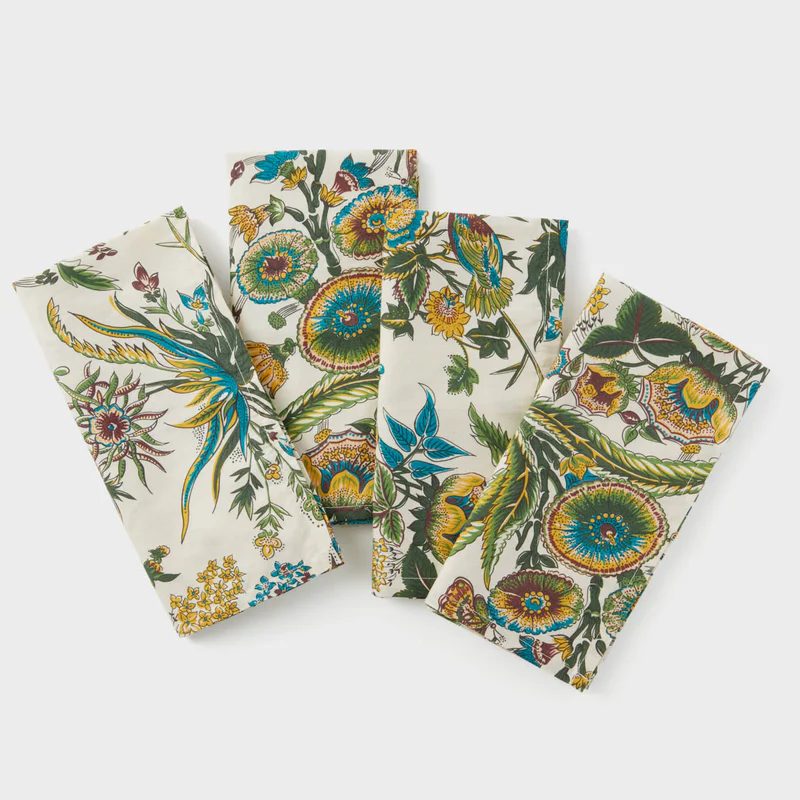
With that ethos in mind, we strive to make versatile prints for our tablecloths and napkins that are washable, durable, and great-looking. We share juicy tips—like clever ways to set a table in a pinch and delicious and easy recipes—and offer the best plates, glasses, flatware, and home essentials to make it all happen.
Q: What are some of your proudest home offerings? What products stand out as extra special?
A: I’m so proud of the assortment we’ve curated—it’s very chic, if I do say so myself! It’s accessible and aspirational at the same time. We offer a range of styles to suit almost everyone’s vibe. Gift giving is a pillar of our home offering, so there’s a mountain of great gifts to choose from—we’ve got you covered.
Q: How do you go about selecting products to carry in the home section?
A: My rule of thumb is if I think the founders would buy it, I try to work it into the assortment. They all have such amazing and discerning taste, and our customers resonate with their aesthetic—they’re my guiding light!
Q: What products are customers especially loving, and why do you think this is?
A: Customers love our wipeable, reversible placemats. Not only are they functional and practical, but they’re also beautiful—the ultimate marriage of form and function.

Q: What are your favorite home giftables?
A: Our brass placecard holders are my personal favorite; this year, we’re offering articulated Nantucket baskets, little ears of corn, the sweetest strawberries, and our adorable brass frogs—I’ve gifted these to everyone I know. We also have shell candle holders by Carolina Irving & Daughters, wildly unique scented candles from Flamingo Estate, a great and playful assortment of cocktail napkins and cocktail picks, and the most elegant matchbox by Aerin. We have so many great giftables.
Q: Any home trends you’re especially excited about this year or any that you hope to see take off in the coming months?
A: Well, as any creative worth her salt would say—“We don’t follow trends—we follow our instincts!” But it’s true—we are our customers, so if we’re into something, our hunch is our gal will be too. We love the handmade feel that Sharland England’s splatterware dishes serve up. We’re also into Juliska’s super chic melamine that can withstand almost any toddler’s antics, and we’re loving our selection of stationery. There’s nothing quite as nice as writing a thank-you note on fine paper—chef’s kiss!
Thanks, Tori! PS: Tuckernuck just opened a new retail space located at 1267 Wisconsin Ave NW in Georgetown—be sure to check it out the next time you’re in the area or follow on Instagram @tuckernuckdc!

Sarah Lyon is a New York City-based freelance writer, originally from Bethesda, MD. She contributes to a number of national design and lifestyle publications like Architectural Digest, Apartment Therapy, MyDomaine, the Washington Post, and more. Sarah also works with designers to help them style spaces for photo shoots. Find more shelfies on her Instagram page, @sarahlyon9
Visit corcoranmce.com to search listings for sale in Washington, D.C., Maryland, Virginia, and West Virginia.
Don’t miss a post! Get the latest local guides and neighborhood news straight to your inbox!
Passive House Design Tenet 4: Gasping At Straws – Controlled Infiltration

This is the fifth essay in a series by Peter VanderPoel, AIA, to help explain the fundamental principles and science of Passive House design. Read the first essay outlining the basics here, followed by the article on super insulation here, air barriers here, and thermal bridging here.
We now have Grandmother’s blanket around us, head-to-toe, all thermal bridging eliminated, and a windbreak so that we look an awful lot like a chrysalis. But something seems to be lacking…
Oxygen!
But punching a hole through the envelope ruins our carefully constructed, continuous thermal and air barriers.
In traditional construction, the method for introducing fresh air has been natural infiltration, i.e., leaky walls and windows. Now that we’ve eliminated the leaks with a continuous, uninterrupted air barrier, we need to introduce a purpose-built inlet straw (quick!).

The straw also allows us to exhale carbon dioxide from our lungs into the outdoors.
In the winter, though, that cold, fresh air coming in requires a lot of added heat energy to make it comfortable for the lungs, while at the same time, we’re exhausting stale air that sends a lot of heat energy outside. Your body has to expend energy to warm the incoming air, while the warmth from the outgoing air is lost to the ether.
In addition, our lungs are purposefully flexible to force air in and out. Buildings are rigid, however, and expelling exhaust air creates negative air pressure, which encourages hot/cold/humid outside air to come in through whatever tiny holes exist in the exterior envelope. Inhalation causes the opposite problem with pressurized air that the owner has paid to heat or cool, escaping out through the same, minuscule holes.
The fluctuating pressurization and depressurization that would result from a straw could be mitigated by providing two straws – one for fresh air, one for exhaust. This balanced exchange would eliminate pressure differences between inside and out, keeping the interior air where we want it.
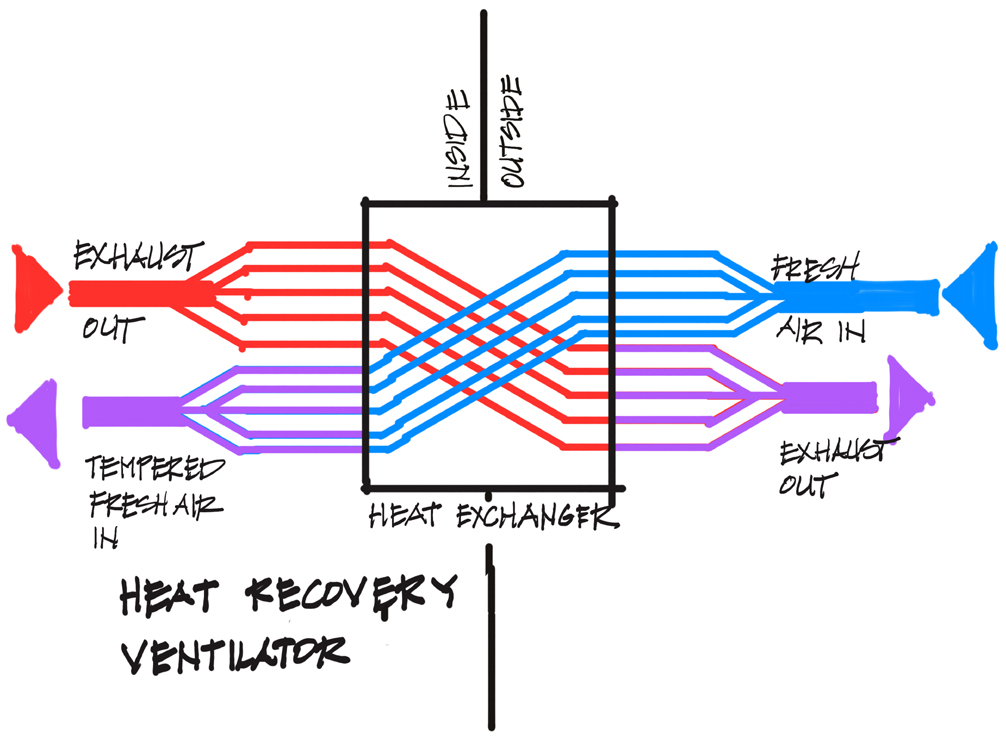
If our two-straw analogy now grows to a, say, 12-straw cylinder with 6 devoted to fresh air coming in and the other 6 to exhaust air going out, evenly mixed within the cylinder. The warm air being exhausted through the outgoing straws would warm the wall of the straw, which would conduct heat to the wall of the neighboring fresh air straw, warming the incoming fresh air. Now we can expend less energy from our body to warm the fresh air. This system, known as a Heat Recovery Ventilator (HRV), is very close to a literal series of tubes passing each other in a heat exchanger. The HRV is recommended for dry climates where humidity is not a concern.
The ERV (Energy Recovery Ventilator) is a similar product, but it can also recover humidity levels from outgoing air to reduce the energy used to adjust the humidity levels from the incoming air.
It was common in older, leakier houses to deliver fresh air and heat in the same tube, the ductwork that runs throughout the house. A furnace, likely located in the basement, would set something on fire: natural gas, oil, coal, etc., and then suck up ‘fresh’ air from the basement, available in copious amounts due to the lack of insulation and air sealing of the basement walls. A fan would then push the air across the flaming heat source (or refrigeration tubing) through the ducts to the various living spaces. Standard, too, was the practice of oversizing the equipment, just to be sure. In many parts of the country, hot summer days come with high humidity. Air conditioners can alleviate both problems, but the oversized systems would quickly provide cooler temperatures and switch off without addressing the high humidity, leaving discomfort and mold to grow on the walls and the inhabitants.
Now, fresh air requirements have remained the same, but with the substantial energy reduction from Passive House design, the heating and cooling requirements have decreased dramatically. The solution tends to be a separation of the two; a ventilation system introduces and distributes filtered, fresh air, and a separate system heats and cools the air already in the space.
Also falling by the wayside are HVAC systems using flaming combustibles to heat homes, which are losing market share to electric heat pumps. The principle of the heat pump is that it doesn’t create heat; it relocates it in a similar way you can move water from one place to another by using a sponge.
The weather service may tell us that it may be cold today, but it will be colder tomorrow: the difference is heat. Improved heat pump technologies are able to provide sufficient amounts of heat from cold air in most circumstances. If you go to the outdoor unit on a cold day, you’ll feel even colder air coming out of the unit after the warmth has been squeezed out of it, transferred to a fluid, piped into your house, with a breeze blown across the pipe.
Every building has to breathe. The problem with older houses is that they hyperventilate. Air moving in and out through holes and seams at the perimeter of the building allows energy and air quality to go out the window (figuratively and literally) in the process.
Next up: Tenet 5 – Can you see what’s coming next?

VanderPoel Architecture is located in Arlington, Virginia, and designs residential and light commercial projects throughout the Washington, DC metro area.
Peter VanderPoel AIA
703.725.4328
peter@pvanderpoel.com
Visit corcoranmce.com to search listings for sale in Washington, D.C., Maryland, Virginia, and West Virginia.
Don’t miss a post! Get the latest local guides and neighborhood news straight to your inbox!
5 Home Upgrades You Haven’t Thought About Trying

A new year has officially arrived, and now that the holiday decor is packed away and your home is feeling nice and fresh, you might be thinking about taking on a few small design upgrades. By no means do you need to call up a contractor or text your interior decorator friend, though—these five projects are simple enough for you to tackle on your own on a frigid weekend afternoon.
Make the TV More Attractive
Wintertime is all about hunkering down and catching up on new TV shows and favorite movies. It’s widely accepted now that everyone watches TV; there’s no need to try to fully hide yours or eliminate it from your living room design scheme. That said, there are some ways to make your setup appear a bit more aesthetically pleasing. For one, corral the cords. A simple box like this one is great for keeping everything organized and out of sight and costs less than $15. Then, think about your display. One fun idea to consider is placing your flat screen TV on an easel. This is particularly appealing if you own a Samsung Frame TV or another TV that is designed to resemble a piece of art when not in use. We’ve rounded up a few easel options below to consider depending on your budget—they’re all majorly design-forward!
- Gallery Easel
- Extra Large Heavy Duty Artist Easel Stand
- Grayfox Art Easel
- Amber Lewis x Four Hands Lakon Light Art Easel
Repurpose a Piece of Furniture
Parting with favorite furniture pieces can be difficult for both sentimental and logistical reasons, so don’t be so quick to list something you’ve loved for many years for sale. Have a secretary desk that has great bones, but find that you rarely use it for work? Consider turning it into an entertaining cabinet. The shelves can hold special pieces of glassware and liquor bottles, while the drawers are useful for tucking away napkins, coasters, and more. On the other hand, maybe you’ve recently pared back on alcohol and are wondering what to do with your beautiful bar cart. Try it in the bathroom—it would look super chic holding folded towels, perfumes, and a candle—or arrange it so that it serves as a tea or coffee bar instead.
Touch up Random Nail Holes and Scuffs
If your walls are looking a little lackluster, you can revamp them in just minutes using a couple of handy and inexpensive products. Magic Eraser sponges are perfect for wiping off scuffs and dirt in seconds, while this drywall putty works wonders in covering up nail holes. These fixes are so easy, you’ll wonder why you didn’t tackle them sooner!
Organize Your Backstock in the Bathroom
If your bathroom closet or under-sink area is flowing with lotions and potions galore, it’s time to get organized. Keep all of your backstock, travel minis, and other essentials organized by category using small clear drawers like these. They’re stackable, easy to open and shut as needed, and will help you find exactly what you need in an instant. Not sure where to begin? Consider putting sunscreens in one bin, extra daily makeup in another, mini shampoos in another, and so on.
Design a Cozy Canopy Bed
Romanticize your winter slumbers by designing the canopy bed you’ve always dreamt of—this style of bed is majorly in vogue at the moment and is easy to DIY. If you already have a four-poster bed, sheer curtains like these will add a dreamy touch in no time and come in a range of colors. If you’re willing to invest more in this project, you can order higher-end custom curtains (we love these!) and attach them to your four-poster frame using drapery hooks.
Sarah Lyon is a New York City-based freelance writer, originally from Bethesda, MD. She contributes to a number of national design and lifestyle publications like Architectural Digest, Apartment Therapy, MyDomaine, the Washington Post, and more. Sarah also works with designers to help them style spaces for photo shoots. Find more shelfies on her Instagram page, @sarahlyon9
Visit corcoranmce.com to search listings for sale in Washington, D.C., Maryland, Virginia, and West Virginia.
Don’t miss a post! Get the latest local guides and neighborhood news straight to your inbox!
How to Style Mid-Century Modern Pieces Like a Pro

Mid-century modern furniture and decor aren’t going away anytime soon. If you love the MCM look and are eager to embrace it in your home, by all means, do so. To really take your design scheme to the next level, though, you’re going to want to consult the following tips from experts, who speak to how to honor mid-century modern style in a way that’s timeless and elegant.
Prioritize Natural Materials
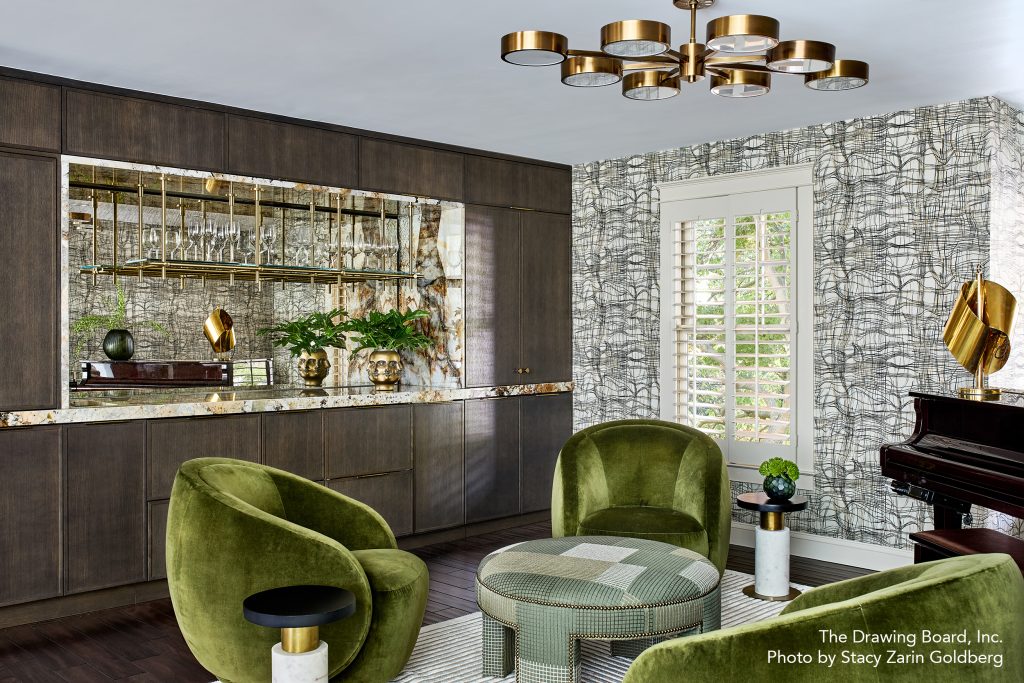
Mid-century modern style is all about embracing the natural. “Many mid-century items are metal or wood, both of which age very well, and can fit into many types of decor,” says Peter Miles, principal of The Drawing Board, Inc. “Mid-century pairs best with other styles and spaces that emphasize clean lines and real materials,” he adds, noting that stone is another strong option.

Try Chairs or a Hutch
Two pieces of mid-century modern furniture that are always winners in Miles’ book include chairs and hutches. “Midcentury modern chairs are an excellent way to bring personality into a space without overwhelming it,” he says. “To bring more definition to a room, simple, streamlined bookshelves or a hutch will add a distinct element of midcentury modern design. Paired with smaller, simple items, these built-ins stand the test of time.”
Weave in Softer Touches
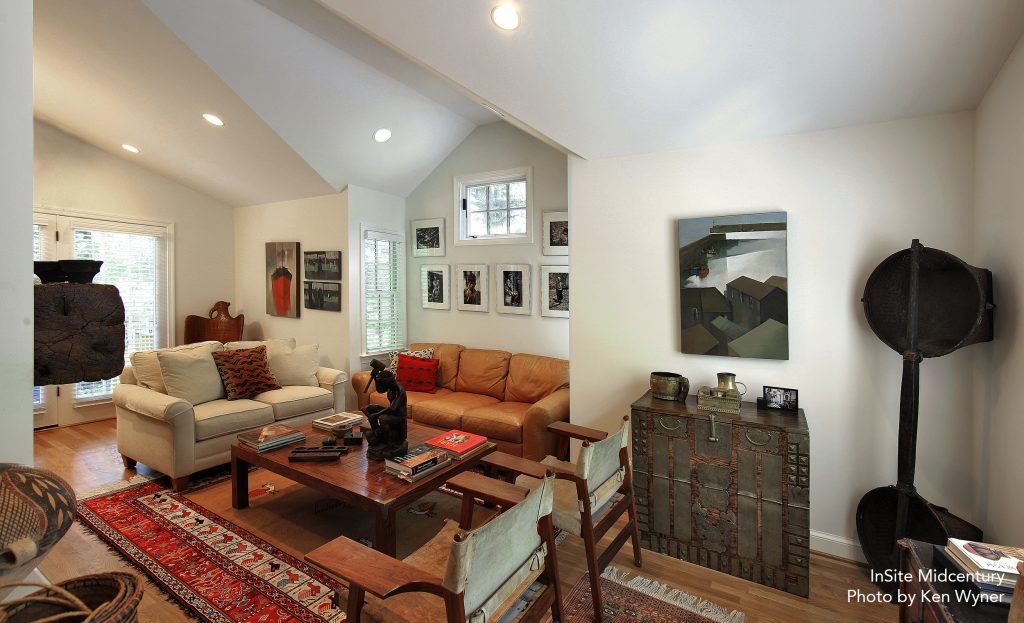
While clean lines and mid-century modern style go hand in hand, it’s important to also balance this out by bringing in some softer elements. “Curved or upholstered furniture balances the straight lines of midcentury frames,” says Dallen Russell, a remodeling advisor at InSite Builders & Remodeling.
Modernize the Space
Russell is all for pairing MCM pieces with newer accents. “Contemporary artwork and modern lighting, including sleek metal floor lamps or simple globe pendants, introduce an updated note that prevents the space from feeling like a time capsule instead of a contemporary home,” he says. Not looking to go ultra-mod? There are plenty of other aesthetics that will mesh nicely with MCM, Russell adds. “Traditional or global elements, too, such as handwoven rugs, carved stools, or pottery with cultural patterning, bring individuality to a room so it feels thoughtfully curated rather than all matched,” he explains. The end result will tell a stylish story throughout eras. Tracy Morris, the founder of Tracy Morris Design, agrees with this approach and likes to mix traditional elements into her own mid-century modern spaces. “This adds warmth and prevents the room from feeling too one tone,” she says.
Sarah Lyon is a New York City-based freelance writer, originally from Bethesda, MD. She contributes to a number of national design and lifestyle publications like Architectural Digest, Apartment Therapy, MyDomaine, the Washington Post, and more. Sarah also works with designers to help them style spaces for photo shoots. Find more shelfies on her Instagram page, @sarahlyon9
Visit corcoranmce.com to search listings for sale in Washington, D.C., Maryland, Virginia, and West Virginia.
Don’t miss a post! Get the latest local guides and neighborhood news straight to your inbox!
Expert Tips for a Beautiful Fall Porch

This week’s blog post is provided by Artscapes Living.
Fall is here, and I love dressing up a porch! But this year, I want to help you think beyond the basic pumpkin for porch decor — something that’s both stunning and smart. Ideas that focus on sustainability, longevity, and truly impactful curb appeal that enhances your home’s aesthetic long past the season.
Invest in Decor Essentials that Last
To achieve this, I recommend investing in decor essentials that last. Choose high-quality faux gourds and pumpkins that you can reuse year after year (while mixing in a few real ones for authenticity!). Opt for durable wreaths, garlands, and sturdy containers that become permanent fixtures. This approach saves you time, money, and reduces waste.
Choose Plants for Multi-Seasonal Appeal
Think beyond mums! When selecting plants for your porch, take a multi-seasonal approach. Incorporate evergreen container plants like dwarf boxwoods for winter structure, or late-blooming perennials such as asters for extended fall color. Potted ornamental grasses also add fantastic texture that lasts.
Integrate with Your Porch Hardscaping
Finally, integrate your decor with your porch’s existing hardscaping. In other words, let the natural tones of your stone or brick guide your accent colors. Use columns for hanging decor, vary the heights of containers on steps, and don’t forget strategic lighting to highlight your beautiful fall display as evenings grow shorter.
By making these thoughtful choices, your fall porch will offer a breathtaking welcome, year after year, and contribute to your home’s enduring beauty.
—
If you’ve always wanted a stunning porch, don’t let another season pass! Schedule your free consultation with me.
Pragya Mishra is the Founder and Principal of Artscapes, LLC, a Northern Virginia-based landscape architecture firm that specializes in designing outdoor transformations that bring you joy. With 22 years of professional experience, she works closely with each client and her network of top-tier contractors to make each project vision a reality. Follow Artscapes on Instagram @artscapes_living and see examples of past projects on her website, www.artscapesliving.com.
Visit corcoranmce.com to search listings for sale in Washington, D.C., Maryland, Virginia, and West Virginia.
Don’t miss a post! Get the latest local guides and neighborhood news straight to your inbox!
7 Organizing Products Pros Swear By

Looking to get your home into tip-top shape before holiday guests arrive in the coming weeks? There’s no time to start prepping like the present! If you’re in need of some handy solutions that will get your space looking nice and streamlined, look no further than the seven products below, which pro organizers rely upon time and time again. They’re more than worth incorporating into your house if you haven’t done so already.
Mirrors with Jewelry Organizers
No getting-ready space is complete without a full-length mirror that allows you to easily evaluate your outfit, but why not take things a step further? Kinsley Turnipseed, the founder of My Other Mother, LLC, recommends investing in a mirror that also conceals a jewelry organizer—this one, which mounts over a door, is an excellent option. Not only does this solution save space, but it also makes it easy to grab those essential finishing touches—necklaces, bracelets, earrings, or all of the above—without having to rummage through a jewelry box.

A Woven Basket Cord Charger
Turnipseed is also a proponent of purchasing woven baskets specifically made to conceal chargers and cords, noting that this solution is “aesthetically pleasing and functional” and comes in handy both on countertops and in work stations.
A Label Maker
If you don’t already own a label maker, consider this your sign to buy one. “Labels are a simple solution that make your things look more organized,” says Jean Prominski, the founder of Sparkle Home Organizing. “They show that you are intentional about what goes where, and that you’ve put energy into keeping it that way.”

Photo: Jean Prominski
Rotating Spice Racks
There’s nothing better than a spice rack that spins, Prominski explains. “A two-tiered rotating spice rack makes it easy to see what you have, and uses the vertical space well,” she says. Best of all, you can scoop these up for just $10. Solutions like these aren’t just for the kitchen, either. “Utilize in the bathroom to see all of your products or even under the sink to easily access cleaning supplies,” suggests Rachel Gitzen, the founder of Rah and Co.
Stackable Clear Bins
It’s time to stop allowing your makeup to roll around aimlessly within your bathroom drawers. Gitzen is a proponent of sorting products by category within clear bins that make it easy to see everything that you have on hand.

Photo courtesy of Rachel Glitzen
A Drawer-Sized Knife Block
Free up countertop space by purchasing a knife block that can live inside your utensil drawer, Gitzen offers. You can still access everything you need seamlessly as you cook (and cleanup is still nice and simple, too).
A Baseball Hat Hanger
Corral your collection of baseball hats once and for all with a designated hanging system that will make it easy to see what you have. “You can see your whole collection, making it easy to pick and even easier to hang back up,” Gitzen says.
Sarah Lyon is a New York City-based freelance writer, originally from Bethesda, MD. She contributes to a number of national design and lifestyle publications like Architectural Digest, Apartment Therapy, MyDomaine, the Washington Post, and more. Sarah also works with designers to help them style spaces for photo shoots. Find more shelfies on her Instagram page, @sarahlyon9
Visit corcoranmce.com to search listings for sale in Washington, D.C., Maryland, Virginia, and West Virginia.
Don’t miss a post! Get the latest local guides and neighborhood news straight to your inbox!
Perennials to Plant in September

This week’s blog post is provided by Artscapes Living.
Many people believe that once the warm days of summer are gone, the gardening season is over. But for us gardeners, September is the perfect time to get our hands dirty and prepare for a spectacular spring display. Planting perennials in the early fall gives them a head start. Their roots get a chance to grow strong before the ground freezes. This means they will be ready to burst into life with vibrant color and foliage the moment spring arrives.
Here are five of the best perennials you should be planting this September to ensure a breathtaking garden next year:

Asters (Symphyotrichum)
These cheerful, daisy-like flowers are a fantastic addition to any Virginia garden, providing beautiful late-season color that can extend into fall. With varieties offering shades of purple, pink, white, and blue, asters are also a valuable nectar source for pollinators. I suggest you plant aster seeds or transplants in early fall to give them ample time to settle in.

Bee Balm (Monarda didyma)
An excellent choice for fall planting, Bee Balm is a vibrant and fragrant perennial that I’ve seen thrive in full sun and well-drained soil. Its unique, shaggy flowers attract hummingbirds, bees, and butterflies, making it a lively addition to your garden. Planting it in September ensures a robust display of red, pink, or purple blooms next summer.

Blazing Star (Liatris spicata)
For a distinctive vertical element, I suggest you consider the Blazing Star. This unique flower sends up tall spikes densely packed with purple florets, creating a striking visual. I’ve found that sowing the seeds of this flower in September is ideal because they need a period of cold to properly germinate for a stunning bloom performance the following year.

Grape Hyacinth (Muscari)
These charming, small bulbs are a classic sign of spring. I’ve always loved how they carpet the ground with clusters of bell-shaped, often blue or purple, flowers. Fall is the perfect season to plant these low-maintenance bulbs, and doing so in September allows them to establish well for an early and delightful burst of color.

Hellebore (Helleborus)
I’ve learned that hellebores are a true garden treasure. Known for their elegant, winter-blooming flowers, they provide color when little else is in bloom. Hellebores should be planted in the fall. If you’re planting from seed, do so in September so they can experience a necessary chilling period of about 60 days to germinate. These shade-loving plants are perfect for bringing life to shadier spots.
So, don’t put away your gardening gloves just yet! Head out and take advantage of the perfect planting conditions this September to set your garden up for a truly spectacular spring. Happy gardening!
Is your garden ready for its next big step? Contact me today to schedule a free 15-minute phone consultation to create a personalized plan for your garden.
Pragya Mishra is the Founder and Principal of Artscapes, LLC, a Northern Virginia-based landscape architecture firm that specializes in designing outdoor transformations that bring you joy. With 22 years of professional experience, she works closely with each client and her network of top-tier contractors to make each project vision a reality. Follow Artscapes on Instagram @artscapes_living and see examples of past projects on her website, www.artscapesliving.com.
Visit corcoranmce.com to search listings for sale in Washington, D.C., Maryland, Virginia, and West Virginia.
Don’t miss a post! Get the latest local guides and neighborhood news straight to your inbox!
Passive House Design Tenet 3: Speaking of Tongues – Eliminate Thermal Bridging

This is the fourth essay in a series by Peter VanderPoel, AIA, to help explain the fundamental principles and science of Passive House design. Read the first essay outlining the basics here, followed by the article on super insulation here, and air barriers here.
Imagine being outside with Grandmother’s blanket wrapped around you and a sturdy windbreaker from head to toe. Having heard of the legend of flagpoles tasting sweet on bitterly cold days, you press your tongue against one to find out the truth. Grandmother would not be proud. All the efforts put into the thermal barrier and air barrier have been defeated by a conductive failure and an embarrassed, garbled cry for help.

Thermal bridging at its worst.
To be effective, thermal barriers created need to be strictly continuous, and any interruption is considered a thermal bridge. Like myriad holes in an air barrier, these seemingly minor interruptions can add up to substantial energy losses.
Perhaps the most common and easily recognizable thermal bridging happens with wood stud construction. The 2x4s are normally spaced every 16 inches. A 2×4 is actually 1.5 inches wide, with a typical wall consisting of drywall attached to the inside face and plywood to the outside. But, a 2×4 is not a good insulator – it has an R-value of about 4.5 total and represents the infamous “path of least resistance” for heat loss. (R-values were discussed in the article on Tenet 1: Super Insulation.)
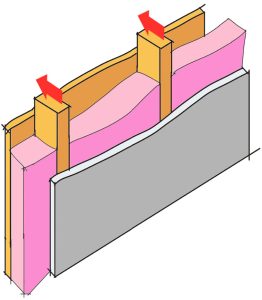
Thermal bridging at wall studs.
We can calculate the degraded R-value in a typical wood stud wall: A stud bay of 16 inches will have 1.5 inches of that distance given over to wood studs. If we include the extra studs at the corners and top and bottom plates, nearly 10% of the wall is solid wood.
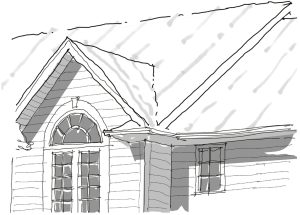
Thermal bridging at roof rafters.
Perhaps the easiest place to see thermal bridging is after a light snow. Many roofs will develop a striped pattern where snow accumulates above the batt insulation, but has melted where the roof rafters are located.
A common design feature for large apartment buildings is to provide a cantilevered balcony without any columns or cables supporting the outer edge. This is accomplished through a structural material, usually steel or concrete, that is necessarily continuous with the interior floor system of the apartment. As mentioned earlier, most insulations are designed with pockets to hold air. This creates a low-density material (where density is measured in weight per volume, i,e, lbs/cubic foot). Steel and concrete are fabulously dense and, in the example of the cantilevered balcony, would transfer phenomenal amounts of energy to the outdoors. There are serious efforts to create an interstitial material that can eliminate the thermal break but maintain the structural continuity to accomplish a cantilevered balcony.
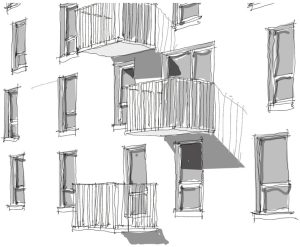
Thermal bridging at a balcony.
Although it’s possible to include the cantilevered projections in the thermal envelope, it is a difficult detail to accomplish. The most direct method is to have the balcony suspended (by cables) or supported (by columns) at the outer edge with the structural materials discontinuous with the interior floor structure. Some mechanically attached exterior cladding requires a “spot” calculation for “point” thermal bridging.
So, how do you design to reduce the effects of thermal bridging? WUFI (“Wärme und Feuchte Instationär,” which translates as “Heat and Moisture Intransient”) is a software package that allows designers to calculate and evaluate the performance of the design before construction begins. Although the goal is to avoid thermal bridging, there is a module in WUFI to calculate thermal bridging losses, accepting the energy losses while still receiving Passive House certification.
To combat the most common thermal bridging in wood stud construction, the easiest solution is continuous insulation. This method keeps the wood stud construction similar to what was mentioned before, but adds a layer of rigid insulation outboard of the standard wood frame to blunt energy losses of the wood studs. This method has now appeared as a required component in building codes.
Next Time: Tenet 4 – Eyes Glazed Over…
VanderPoel Architecture is located in Arlington, Virginia, and designs residential and light commercial projects throughout the Washington, DC metro area.
Peter VanderPoel AIA
703.725.4328
peter@pvanderpoel.com
Visit corcoranmce.com to search listings for sale in Washington, D.C., Maryland, Virginia, and West Virginia.
Don’t miss a post! Get the latest local guides and neighborhood news straight to your inbox!
10 Fall Finds for the Home Under $50
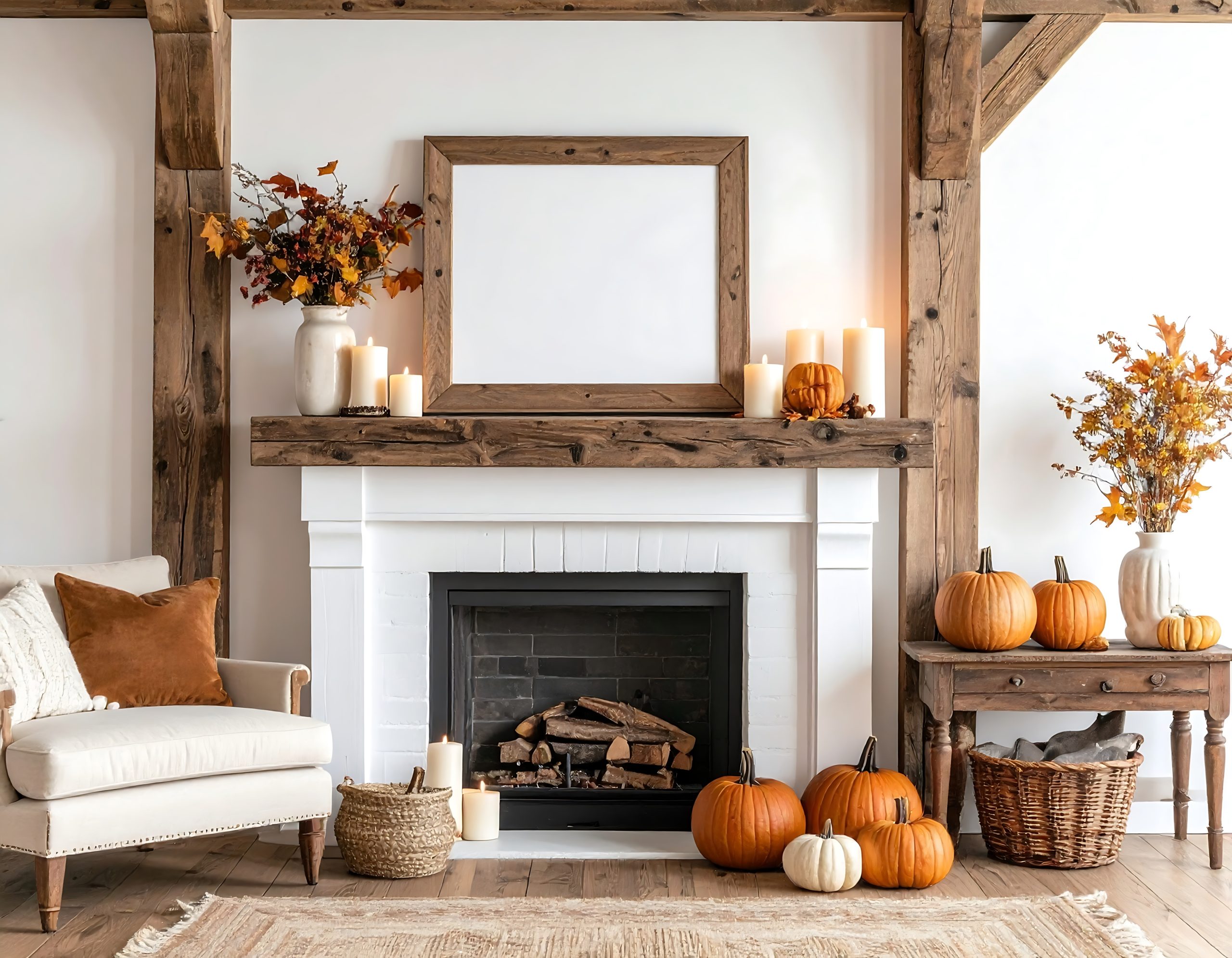
Ready to spruce your space up in honor of the start of a new season? The great news is you certainly don’t have to break the bank while doing so. This fall, we’re embracing traditional touches, warm textures, and moody artwork—you can find all of that and then some below at prices that are almost too good to be true!

Burlwood is having a major resurgence this fall, and this frame couldn’t be prettier. Whether you use it to display an art piece or a family photo, it’ll add tons of character and dimension to any wall or tabletop.

Elevate your morning coffee ritual with a set of four teaspoons that feature a wood and metal combo that is perfect for the season.

Welcome the harvest season into your home by displaying this print in your kitchen or entryway—it comes in a framed canvas, so all you have to do is unwrap it!

Restyling your coffee table to mark the beginning of autumn is always a nice refresh. This candle would look lovely placed on top of a stack of books and is sure to smell dreamy thanks to its mixture of pumpkin, cinnamon, nutmeg, and more.

Kids and adults alike will enjoy snuggling up under this ghost and bat-themed throw. The design says Halloween, while the simple black and white color palette prevents the design from being cheesy or over the top.

Cluster a few of these ceramic pumpkins on your mantel top or dining room table to instantly bring autumn into your home. Their neutral hue will take you from Halloween to Thanksgiving in a snap.

Use a printed tray like this one to corral baubles or lotions in your bathroom or on the bedside table.

Splatterware is majorly in vogue these days, and this mug will make you actually look forward to brewing your own cup of joe at home.

Add instant color to your front entryway with the help of this realistic-looking garland that requires zero maintenance and is suitable for indoor and sheltered outdoor use alike.

These taper candles will liven up your home in an instant and are available in three festive, seasonal hues. Commit to one or mix and match!
Sarah Lyon is a New York City-based freelance writer, originally from Bethesda, MD. She contributes to a number of national design and lifestyle publications like Architectural Digest, Apartment Therapy, MyDomaine, the Washington Post, and more. Sarah also works with designers to help them style spaces for photo shoots. Find more shelfies on her Instagram page, @sarahlyon9
Visit corcoranmce.com to search listings for sale in Washington, D.C., Maryland, Virginia, and West Virginia.
Don’t miss a post! Get the latest local guides and neighborhood news straight to your inbox!